Official Saudi government website links end with edu.sa
All official educational website links in the Kingdom of Saudi Arabia end with .sch.sa or .edu.sa

An official government website affiliated with the Government of the Kingdom of Saudi Arabia


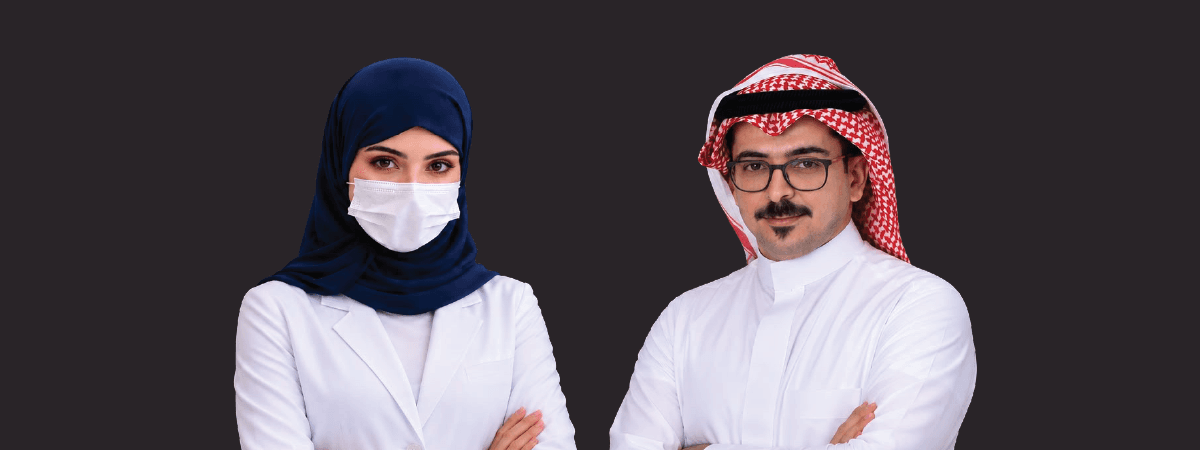


Dr. Majed Saad Al-Touman, Assistant Professor and Consultant in Prosthodontics at the College of Dentistry at King Khalid University, and Dr. Manar Khalid Al-Omari, a fellow in the University's Prosthodontics Fellowship Program, have been granted a patent by the Saudi Authority for Intellectual Property for their invention, "Flexible Gingival Retraction Cord with Adjustable Ties." The invention aims to develop a more flexible device that can adapt to different tooth sizes and shapes, potentially addressing some of the challenges associated with gingival retraction procedures.
Dr. Al-Touman explained that the invention was developed to address the limited adaptability of conventional gingival retraction cords to variations in tooth size and shape. These cords typically have a fixed diameter, which may make them difficult to secure or cause them to slip out of position. They may also exert uneven pressure on gingival tissues. Furthermore, using a separate cord for each tooth can increase the time and effort required, particularly in cases involving the preparation of multiple teeth.
He explained that the invention is based on a flexible gingival retraction cord with a spiral structure consisting of successive loops interconnected by adjustable ties. These ties allow the diameter of each loop to be adjusted according to the dimensions of the tooth, helping improve the cord's adaptability and stability during use.
He added that the design allows a continuous cord to be used around several adjacent teeth instead of requiring a separate cord for each tooth. It also features a package equipped with a dispenser for gradually dispensing the cord and an integrated cutter for determining the required length, providing a more flexible mechanism for meeting the requirements of different dental procedures.
Dr. Al-Touman noted that the invention aims to improve the efficiency of gingival retraction procedures in prosthodontics, including preparations for crowns and bridges, conventional dental impressions, and cases requiring the preparation of multiple teeth or full-mouth rehabilitation. He explained that these features may help reduce clinical time and effort, minimize material consumption, and improve patient comfort.


