Official Saudi government website links end with edu.sa
All official educational website links in the Kingdom of Saudi Arabia end with .sch.sa or .edu.sa

An official government website affiliated with the Government of the Kingdom of Saudi Arabia



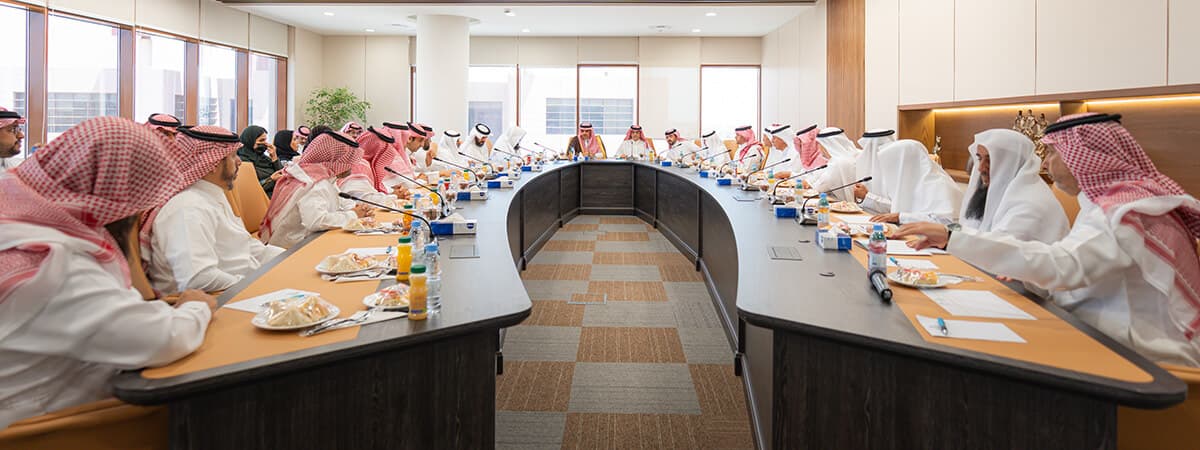


In the presence of His Excellency the President of King Khalid University, Prof. Faleh bin Rajaallah Al-Sulami, the university, represented by the General Administration of Volunteerism and Community Partnership, launched the "We Listen to You to Grow Together" initiative and held its first meeting at the Al-Faraa University City campus. The event was attended by university leaders, the Head of Al-Wadiyain Center, Mr. Saad bin Abdullah Al Thabet, heads of government entities, and several distinguished members of the local community. This step reflects the university's commitment to strengthening direct communication with the local community, listening to its needs, and building effective developmental partnerships that contribute to achieving sustainable impact.
The meeting lasted approximately two hours and featured an open dialogue addressing the most significant needs and challenges facing the local community. His Excellency the University President and university leaders listened to participants' suggestions and inquiries and discussed ways to benefit from the university's academic, research, consulting, medical, and volunteer capabilities to provide practical solutions that enhance quality of life and address community needs. The meeting concluded with a luncheon held for the attendees in an atmosphere that reflected the spirit of familiarity and communication between the university and representatives of the local community.
Commenting on the initiative, Dr. Misfer bin Mohammed Al-Asmari, Supervisor of the General Administration of Volunteerism and Community Partnership, emphasized that the "We Listen to You to Grow Together" initiative aims to strengthen communication with the centers and villages surrounding the university by organizing field meetings and dialogue platforms dedicated to listening to the needs of the local community, identifying and analyzing developmental, service, and social challenges, and linking them to the university's educational, research, consulting, medical, and volunteer capabilities, ultimately leading to practical initiatives and impactful partnerships that generate tangible benefits for the community.
He explained that the initiative seeks to identify the needs of the local community, monitor its development priorities, utilize the university's expertise to address those needs, strengthen partnerships with relevant entities, launch development initiatives that contribute to improving quality of life, and reinforce the university's role as a center of expertise and a leader of development within its community.
Al-Asmari noted that the initiative covers several priority areas, including education and capacity building, health and quality of life, entrepreneurship and economic empowerment, community services and local development, environment and sustainability, technology and digital transformation, culture and heritage, tourism and local development, youth and future skills, productive families and small enterprises, as well as innovation and community-based solutions.
Al-Asmari also highlighted the importance of continuing these meetings on a regular basis to strengthen the bonds of communication between the university and the community, enabling the follow-up of identified needs and proposals and transforming them into practical initiatives and programs in partnership with the relevant entities.


