Official Saudi government website links end with edu.sa
All official educational website links in the Kingdom of Saudi Arabia end with .sch.sa or .edu.sa

An official government website affiliated with the Government of the Kingdom of Saudi Arabia



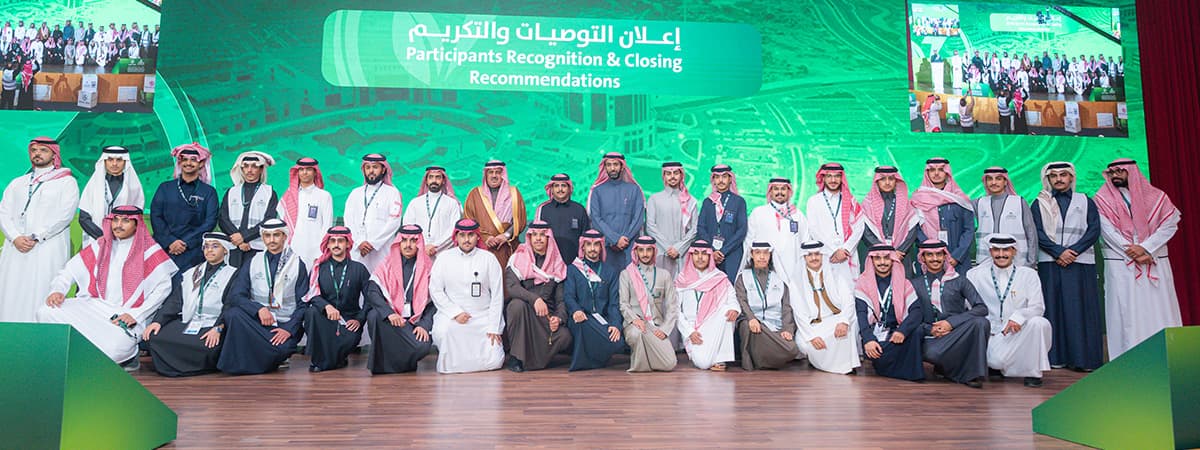


His Excellency the President of King Khalid University, Prof. Faleh bin Rajaallah Al-Solami, witnessed the conclusion of the Sustainable Solutions in Energy and Environment 2025 Conference, which was held under the generous patronage of His Royal Highness Prince Turki bin Talal bin Abdulaziz, Emir of Aseer Region and Chairman of its Development Authority, and organized by the College of Engineering at the Exhibitions and Conventions Center in the University City in Al-Fara'a. The conference concluded after two days of scientific and dialogue discussions involving experts and researchers from national and international entities.
His Excellency the University President honored the students who won the scientific competitions and recognized the participants and partner entities. The events also saw a wide presence and participation of over 35 speakers and experts from more than 15 countries across 5 different continents, alongside the Awareness and Communication Exhibition for the Fifth Initiative for Human Capacity Development in the Energy Ecosystem, and the "Engineer's Day Exhibition," which featured over 30 student projects in the fields of energy, innovation, and engineering.
The conference's scientific program comprised 10 main and dialogue sessions, and 4 scientific sessions, during which 23 research papers were discussed, 42 scientific posters were presented, and 9 specialized workshops were held. This scientific diversity contributed to enhancing the exchange of expertise and showcasing the latest practices and innovations in clean energy and sustainable environment.
The Chairman of the Conference Scientific Committee, Dr. Saad bin Fahad Al-Jabbar, pointed out that the recommendations resulting from the sessions were comprehensive of the main tracks in energy and environment. They called for accelerating the adoption of clean and smart energy systems and raising their national readiness, enhancing carbon management technologies and circular economy applications, in addition to developing environmental monitoring systems and protecting ecosystems in arid environments. The recommendations also emphasized the necessity of supporting water sustainability, expanding advanced treatment technologies, and linking them to renewable energy sources, and promoting innovation in sustainable materials and green chemistry to meet industrial needs.
The recommendations also included enabling multi-sectoral cooperation to establish shared innovation environments, establishing the conference as a continuous scientific platform through annual research programs and challenges, in addition to supporting capacity building and human capital development in the fields of energy and environment, and aligning research efforts with the goals of Saudi Vision 2030 and the priorities of the research and innovation ecosystem.


