Official Saudi government website links end with edu.sa
All official educational website links in the Kingdom of Saudi Arabia end with .sch.sa or .edu.sa

An official government website affiliated with the Government of the Kingdom of Saudi Arabia



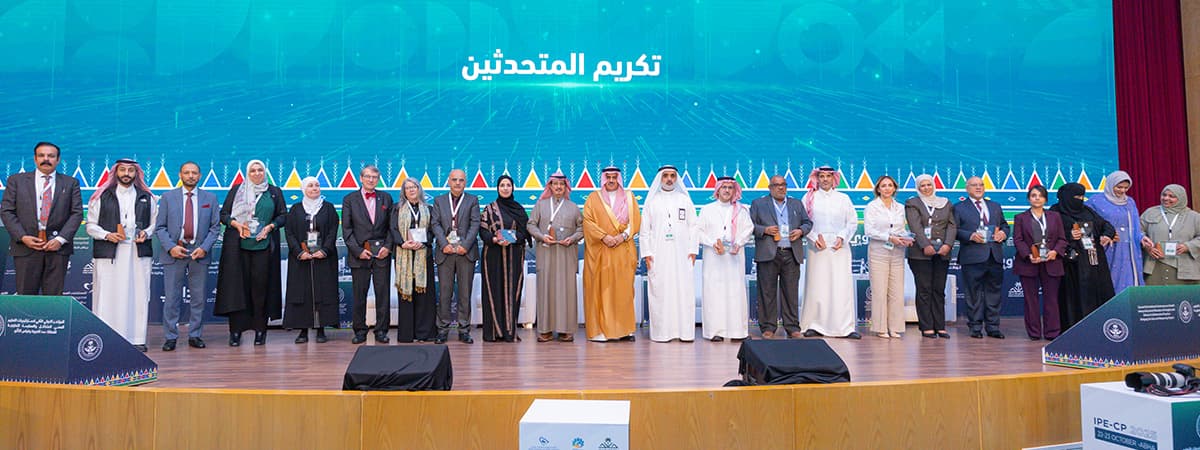


Under the generous patronage of His Royal Highness Prince Turki bin Talal bin Abdulaziz, Governor of Asir Region and Chairman of its Development Authority, King Khalid University inaugurated the activities of the Second International Conference on Interprofessional Health Education Strategies and Effective Collaborative Practice. The conference is held under the slogan: "Bridging the Gap... Measuring the Impact," and includes the participation of an elite group of deans of colleges of medicine in the Gulf Cooperation Council (GCC) countries and Saudi universities, medical education experts, and clinical practice pioneers from within and outside the Kingdom.
In his speech during the opening ceremony, His Excellency the President of King Khalid University, Prof. Faleh bin Rajaallah Al-Solami, emphasized that the University views health education as a structural axis in its national and scientific mission, and a primary component in the making of development and the building of people. He noted that the conference is an extension of the University's approach in strengthening the integration of health specialties and activating interprofessional education based on professional partnership and social responsibility.
His Excellency explained that holding the conference under the patronage of the Emir of the Region embodies the University's connection to the priorities of the Asir Region Development Strategy, which stems from Saudi Vision 2030, and supports the trend towards building a health system with a developmental impact. He commended the pivotal role of the Ministry of Education and the University Affairs Council in empowering Saudi universities and directing their path toward knowledge leadership.
His Excellency pointed out that the University was keen that the conference should not be merely a platform for presenting scientific papers, but rather an integrated experience that includes workshops, health exhibitions, active student participation, exchange of institutional expertise, and keeping pace with transformations in curricula and programs. This is to enhance the alignment of health education outcomes with the needs of development and health transformation in the Kingdom.
His Excellency highlighted the national scientific and institutional integration achieved through the partnership with the Arab Network for Interprofessional Health Collaboration (ANIC) and the Saudi Society for Medical Education (SSME), stressing that this represents a model for embodying shared knowledge and transforming it into tangible impact. He also valued the support of partners and sponsors from the health sector, whose presence he described as "a reflection of the private sector's belief in the responsibility of supporting knowledge and scientific research."
For his part, the Dean of the College of Medicine, Professor Dr. Ali bin Saeed Al-Qahtani, welcomed the guests and participants, confirming that the convening of the Second International Conference on Interprofessional Health Education Strategies and Effective Collaborative Practice embodies King Khalid University's commitment to its mission in promoting integration between health disciplines and activating collaborative education in line with the aspirations of Saudi Vision 2030, aligning with the requirements of the health transformation in the Kingdom, and consistent with the Asir Region Development Strategy towards an integrated health system based on efficiency and quality in serving humanity.
Al-Qahtani explained that the conference keeps pace with modern developments in interprofessional education for health colleges by strengthening teamwork, exchanging knowledge and experiences, developing curricula and learning outcomes, restructuring academic programs, and establishing an institutional framework for interprofessional professional education. This is achieved with the participation of an elite group of leaders and international experts in cooperation with the Arab Network for Interprofessional Health Collaboration and the Saudi Society for Medical Education at King Khalid University, reviewing the best practices and research that enhance the quality of health education and reflect an impact on serving the community and humanity.
The attendees also watched a visual presentation documenting the journey of the College of Medicine at King Khalid University and its national and educational leadership. The ceremony included honoring the former deans of the College of Medicine who led the stages of the college's establishment and development over nearly five decades, in recognition of their journey in building national medical competencies. His Excellency the University President also honored the main speakers and participating researchers, in addition to honoring the conference's scientific committee in appreciation of its efforts in preparation and implementation, as well as the sponsors and supporters.


