Official Saudi government website links end with edu.sa
All official educational website links in the Kingdom of Saudi Arabia end with .sch.sa or .edu.sa

An official government website affiliated with the Government of the Kingdom of Saudi Arabia



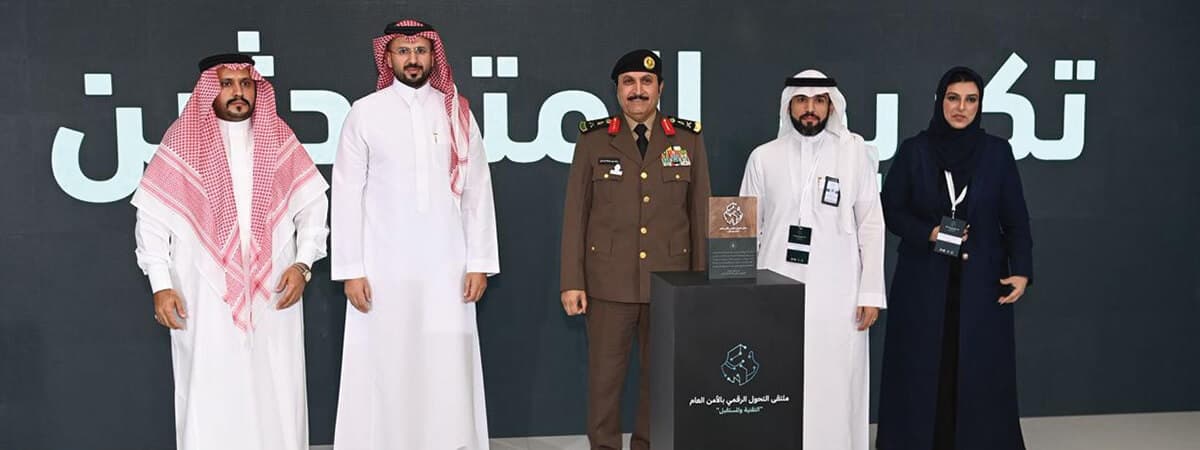


King Khalid University, represented by the University’s Agency for Community Engagement and Partnerships through the Office of Technology Transfer and Intellectual Property Commercialization, participated in the third edition of the Digital Transformation Forum in Public Security, held in Riyadh over two days under the generous patronage of His Royal Highness Prince Abdulaziz bin Saud bin Abdulaziz, Minister of Interior, and in the presence of His Excellency Director General of Public Security, Lieutenant General Mohammed bin Abdullah Al-Bassami, alongside security leaders and specialized experts from various sectors.
Dr. Abeer Al-Almai, Director of the Office of Technology Transfer and Intellectual Property Commercialization, explained that the university’s participation this year aimed to present an advanced national model for utilizing research and innovation outputs to serve security sectors. The university presented more than 14 specialized technical innovations addressing multiple fields in the security sector, including high-risk network protection, explosive detection technologies, drug detection tools, and forensic evidence analysis systems.
She added that these innovations were developed by specialized research teams within the university, leveraging central supportive laboratories and ensuring clear integration among colleges and research centers, achieving alignment between academic directions and national priority needs, particularly in artificial intelligence, cyber analysis, and smart security technologies.
Dr. Al-Almai indicated that this participation reflected the translation of knowledge and research outputs into practical applications with direct impact on the security system. The university’s exhibition booth showcased digital solutions addressing cybersecurity challenges, focusing on preventive and proactive innovations supporting detection and response systems for complex threats.
In addition to technical presentations, the university organized a series of interactive training workshops aimed at knowledge transfer and expertise exchange with security sector personnel. These workshops were conducted by a select group of faculty members and experts in cybersecurity, data analysis, and digital forensics. Dr. Al-Almai conducted a workshop entitled “Enhancing Officers’ Readiness in Digital Security and Financial Fraud”, covering concepts of cybercrime and cross-border financial fraud, key tools for threat protection, and methods to enhance digital security using artificial intelligence and cyber analysis.
Dr. Hamed Al-Qahtani, Dean of the Deanship of Electronic Services, delivered a workshop entitled “The Role of Soft Skills in Building the Human Firewall in Cybersecurity”, discussing the importance of the human element in the security system and the role of personal skills such as emotional intelligence, critical thinking, and stress management in enhancing readiness and response to cyber threats.
Dr. Hesham Al-Asmari, faculty member at the College of Computer Sciences, conducted a specialized workshop on “Digital Evidence Analysis and Forensic Investigations”, covering digital investigation stages, techniques for extracting evidence from computers and smartphones, malware handling methods, and essential software tools used in digital forensic analysis.
Dr. Mohammed Al-Mar’i, Vice Dean of the Deanship of Electronic Services for Information Technology and an information security specialist, presented a workshop entitled “Cyber Readiness in the Era of Digital Transformation”, addressing modern cybersecurity threats targeting the infrastructure of security institutions, emphasizing risk assessment, protection of information systems and networks, and building cybersecurity capabilities in sensitive work environments.


